
India is home to some of the world’s most prominent businesses across energy, banking, telecommunications, information technology, infrastructure, and financial services. The country’s largest listed companies play a major role in economic growth, employment, investment, and the development of key industries.
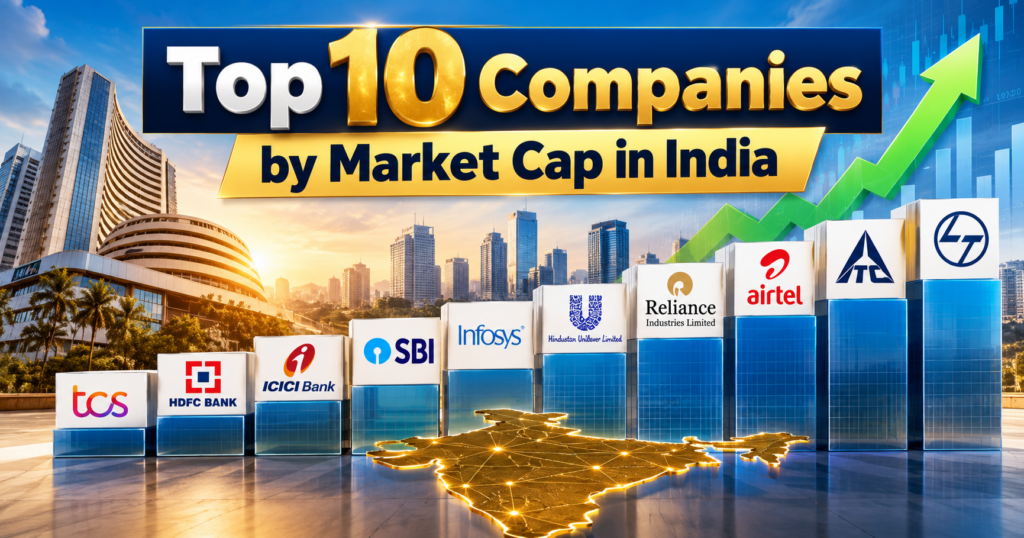
The top 10 companies by market capitalization in India include Reliance Industries, Bharti Airtel, HDFC Bank, ICICI Bank, Tata Consultancy Services (TCS), State Bank of India (SBI), and other leading businesses. Their market values reflect how investors value their shares in the stock market.
Based on market-cap rankings available on 29 October 2026, Reliance Industries leads the list, followed by Bharti Airtel and HDFC Bank. The rankings and values can change as share prices fluctuate. Source: The Economic Times.
Top 10 Companies by Market Cap in India
The following table presents ten of India’s largest publicly listed companies by market capitalization, along with their principal sectors and approximate market values as reported on 29 October 2026.
| Rank | Company | Sector | Approx. Market Cap |
|---|---|---|---|
| 1 | Reliance Industries Limited | Energy and diversified businesses | ₹15.91 lakh crore |
| 2 | Bharti Airtel Limited | Telecommunications | ₹12.14 lakh crore |
| 3 | HDFC Bank Limited | Banking | ₹10.54 lakh crore |
| 4 | ICICI Bank Limited | Banking | ₹9.86 lakh crore |
| 5 | Tata Consultancy Services (TCS) | IT services | ₹8.95 lakh crore |
| 6 | State Bank of India (SBI) | Banking | ₹8.85 lakh crore |
| 7 | Bajaj Finance Limited | Financial services | ₹5.70 lakh crore |
| 8 | Larsen & Toubro (L&T) | Engineering and infrastructure | ₹5.19 lakh crore |
| 9 | Life Insurance Corporation of India (LIC) | Insurance | ₹4.97 lakh crore |
| 10 | Infosys Limited | IT services and consulting | ₹4.57 lakh crore |
Source: The Economic Times’ market-cap screener, accessed 29 October 2026. Figures are rounded from reported values in Indian rupees. Rankings may vary by data provider, market timing, and methodology.
1. Reliance Industries Limited
Reliance Industries Limited is one of India’s largest diversified companies, with business interests spanning energy, retail, telecommunications, digital services, and new energy initiatives. Headquartered in Mumbai, the company has built a broad presence across several sectors of the Indian economy.
Its major businesses include Reliance Retail and Jio, alongside its oil-to-chemicals and energy operations. Its scale, established customer base, and investments in digital infrastructure and consumer markets make it a closely watched company among investors.
Key details:
- Sector: Energy, retail, telecommunications, and diversified businesses
- Market capitalization: Approximately ₹15.91 lakh crore
- Stock exchange: NSE and BSE
- Why it matters: Its presence across multiple major industries gives it a significant role in India’s corporate landscape.
2. Bharti Airtel Limited
Bharti Airtel is a leading telecommunications company providing mobile, broadband, enterprise connectivity, and related digital services. It operates in India and several international markets, serving consumers as well as businesses.
The expansion of 5G networks, demand for mobile data, home broadband, and digital connectivity has made telecom infrastructure an important part of India’s digital economy. Bharti Airtel’s network investments and customer base are key factors investors monitor when evaluating the company.
Key details:
- Sector: Telecommunications
- Market capitalization: Approximately ₹12.14 lakh crore
- Stock exchange: NSE and BSE
- Why it matters: It is a major provider of mobile and broadband connectivity in India.
3. HDFC Bank Limited
HDFC Bank is one of India’s largest private-sector banks. It provides banking and financial products to individuals, small businesses, and large corporate customers. Its services include savings and current accounts, loans, credit cards, digital banking, and wealth-related offerings.
Following its merger with HDFC Limited, the bank expanded its scale and housing-finance reach. Investors commonly monitor its loan growth, deposit mobilisation, asset quality, profitability, and capital position.
Key details:
- Sector: Banking and financial services
- Market capitalization: Approximately ₹10.54 lakh crore
- Stock exchange: NSE and BSE
- Why it matters: Its extensive banking network and lending operations make it a major participant in India’s financial system.
4. ICICI Bank Limited
ICICI Bank is a major private-sector bank offering retail banking, corporate banking, loans, credit cards, insurance-related distribution, and digital financial services. It serves customers through branches, ATMs, online platforms, and mobile banking.
The bank’s performance is influenced by lending growth, deposit costs, net interest margins, fee income, and the quality of its loan portfolio. Its technology-led services and diversified customer base contribute to its position among India’s largest listed companies.
Key details:
- Sector: Banking and financial services
- Market capitalization: Approximately ₹9.86 lakh crore
- Stock exchange: NSE and BSE
- Why it matters: It is a key provider of retail and corporate banking services in India.
5. Tata Consultancy Services (TCS)
Tata Consultancy Services is a global IT services and consulting company within the Tata Group. It works with businesses across industries to modernise technology systems, manage enterprise applications, improve cybersecurity, migrate to cloud platforms, and develop digital solutions.
TCS serves clients across banking, retail, manufacturing, healthcare, telecommunications, and other sectors. Demand for cloud computing, data analytics, automation, and artificial intelligence creates opportunities, while changes in client spending and global economic conditions can affect growth.
Key details:
- Sector: Information technology and consulting
- Market capitalization: Approximately ₹8.95 lakh crore
- Stock exchange: NSE and BSE
- Why it matters: It is one of India’s best-known global IT services exporters.
6. State Bank of India (SBI)
State Bank of India is India’s largest public-sector bank by many measures, with a broad domestic branch network and a substantial presence in retail, corporate, agricultural, and government-related banking.
Its services include deposits, personal loans, business finance, home loans, cards, and digital banking. SBI also operates through subsidiaries and associated financial services businesses.
Investors often examine its credit growth, non-performing assets, deposit growth, operating costs, and profitability to assess its financial performance.
Key details:
- Sector: Banking and financial services
- Market capitalization: Approximately ₹8.85 lakh crore
- Stock exchange: NSE and BSE
- Why it matters: It plays a significant role in public-sector banking and financial inclusion across India.
7. Bajaj Finance Limited
Bajaj Finance is a major non-banking financial company (NBFC) offering consumer finance, personal loans, business loans, loans against property, and other financial products. It has developed a large customer base through a combination of lending products, merchant partnerships, and digital services.
The company’s growth depends on credit demand, customer acquisition, borrowing costs, loan recoveries, and risk management. Investors also track its asset quality and the performance of its lending portfolio as consumer credit conditions change.
Key details:
- Sector: Financial services and lending
- Market capitalization: Approximately ₹5.70 lakh crore
- Stock exchange: NSE and BSE
- Why it matters: It is a prominent participant in India’s consumer and retail lending market.
8. Larsen & Toubro (L&T)
Larsen & Toubro is a major Indian engineering, construction, and infrastructure group. Its activities include large infrastructure projects, heavy engineering, technology services, defence-related manufacturing, and energy-related engineering solutions.
The company’s business is linked to infrastructure development, capital expenditure, industrial investment, and project execution. Its order book, project margins, cash flow, and ability to deliver large contracts are important measures of performance.
Key details:
- Sector: Engineering, construction, and infrastructure
- Market capitalization: Approximately ₹5.19 lakh crore
- Stock exchange: NSE and BSE
- Why it matters: It participates in major infrastructure and industrial projects in India and overseas.
9. Life Insurance Corporation of India (LIC)
Life Insurance Corporation of India is one of the country’s largest life insurance providers. It offers life insurance policies and related long-term financial products to individuals and families, with a large distribution network across India.
LIC’s business includes protection-oriented policies and savings-linked insurance products. Important indicators include new business premiums, policy persistency, product mix, investment performance, and the value of its insurance business.
Key details:
- Sector: Life insurance
- Market capitalization: Approximately ₹4.97 lakh crore
- Stock exchange: NSE and BSE
- Why it matters: It has a significant presence in India’s life insurance market and long-term savings sector.
10. Infosys Limited
Infosys is a global IT consulting and services company that helps businesses with software development, technology modernisation, cloud services, data analytics, cybersecurity, and digital transformation.
The company serves clients across industries, including financial services, manufacturing, retail, and healthcare. Its growth is influenced by technology budgets, client demand, employee utilisation, operating margins, and the pace of digital investment.
Key details:
- Sector: Information technology and consulting
- Market capitalization: Approximately ₹4.57 lakh crore
- Stock exchange: NSE and BSE
- Why it matters: It is a major Indian technology exporter serving clients around the world.
What Is Market Capitalization?
Market capitalization, also known as market cap, is the total market value of a company’s outstanding shares. It is a commonly used measure to compare the stock-market size of publicly listed companies.
Market capitalization formula:
Market capitalization = Current share price × Total outstanding shares
For example, if a company has 100 crore outstanding shares and each share is trading at ₹500, its market capitalization is ₹50,000 crore.
Market cap is not the same as revenue, profit, assets, or the amount of cash a company holds. It represents the market value of its equity based on the share price and the number of outstanding shares.
Why Does Market Capitalization Matter?
Market capitalization can help investors and readers understand the relative size of listed companies and how the stock market values their equity.
Company size comparison: Market cap provides a common measure for comparing companies across sectors, although different industries have different business models.
Investor sentiment: Share prices reflect market expectations about future growth, profitability, risks, and economic conditions. These expectations can affect market capitalization.
Index construction: Market capitalization and related measures are used in the construction and maintenance of many stock-market indices, subject to each index’s methodology.
Portfolio diversification: Investors may use company size and sector exposure as part of a broader investment strategy. Market cap alone, however, does not establish whether a stock is suitable for an individual investor.
Which Sectors Have the Largest Companies in India?
The list highlights the prominence of several sectors in India’s listed equity market.
- Banking and financial services: HDFC Bank, ICICI Bank, SBI, and Bajaj Finance illustrate the scale of India’s lending and financial services industry.
- Telecommunications: Bharti Airtel benefits from the importance of mobile connectivity, broadband, and digital infrastructure.
- Information technology: TCS and Infosys represent India’s global IT services and consulting sector.
- Energy and diversified businesses: Reliance Industries operates across several major business segments, including energy, retail, and digital services.
- Infrastructure and engineering: L&T is connected to industrial investment and infrastructure development.
- Insurance: LIC is a major participant in India’s life insurance industry.
These sectors respond to different economic conditions. Banks depend heavily on credit demand and asset quality, IT services companies on technology spending, and infrastructure businesses on investment and project execution.
Market Capitalization vs. Revenue and Profit
Market capitalization is often confused with other financial measures, but each describes something different.
| Measure | What it means |
|---|---|
| Market capitalization | Market value of a company’s outstanding equity |
| Revenue | Income generated from business operations |
| Net profit | Earnings remaining after expenses and applicable taxes |
| Total assets | Resources reported on the company’s balance sheet |
| Enterprise value | A valuation measure that considers equity value, debt, and cash, using a defined methodology |
A company with a higher market cap does not necessarily have higher revenue or profit than every company ranked below it. Investors also consider expected growth, risk, margins, capital requirements, and future cash flows when valuing shares.
How Often Does the Ranking Change?
The ranking of India’s largest companies can change daily because share prices fluctuate during market trading. Changes in outstanding shares, corporate actions, and differences in data-provider methodology can also affect reported values.
For accurate comparisons, use market-cap figures from the same date and a consistent source. The figures in this article are rounded snapshots rather than permanent valuations.
For official market-related information, readers can consult the NSE India website and the BSE India website. Market-cap screeners from financial publications can also help track changes in the rankings.
Conclusion
The top 10 companies by market capitalization in India reflect the breadth of the country’s corporate economy, from energy and telecommunications to banking, IT services, insurance, and infrastructure. In the cited 29 October 2026 ranking, Reliance Industries holds the top position, followed by Bharti Airtel and HDFC Bank.
These rankings provide a useful snapshot of how investors value India’s leading listed businesses, but they should not be treated as permanent. Market capitalization changes with share prices and is only one of several measures used to understand a company’s financial position and prospects.
Frequently Asked Questions (FAQs)
Which is the No. 1 company in India by market cap?
Based on the market-cap ranking available on 29 October 2026, Reliance Industries Limited is the largest publicly listed Indian company in the list, with a market capitalization of approximately ₹15.91 lakh crore.
Which are the top 5 companies by market cap in India?
The top five in the cited ranking are Reliance Industries, Bharti Airtel, HDFC Bank, ICICI Bank, and Tata Consultancy Services (TCS).
Which is India’s largest bank by market capitalization?
HDFC Bank ranks ahead of other banks in the cited 29 October 2026 market-cap list. Rankings can change as share prices move.
Which is India’s largest IT company by market capitalization?
Tata Consultancy Services (TCS) ranks ahead of Infosys in the cited market-cap list. Both are major Indian IT services and consulting companies.
Is market capitalization the same as a company’s value?
Market capitalization measures the market value of a company’s outstanding equity. It is not the same as enterprise value, book value, revenue, or the total value of all its business assets.
Does market capitalization change every day?
Yes. Market capitalization generally changes as the share price changes. It can also be affected by changes in the number of outstanding shares and corporate actions.
Can an unlisted company appear in a stock-market market-cap ranking?
Unlisted companies do not have a continuously traded public share price in the same way as listed companies. Private valuations may exist, but they are not directly comparable with public-market capitalization rankings.
Does a higher market cap mean a stock is a better investment?
No. A higher market cap indicates a larger market value of equity, not a guarantee of stronger returns or lower risk. Investors should consider valuation, financial performance, debt, cash flow, business risks, and their own investment objectives.
Disclaimer: This article is for general informational and educational purposes only. Market-cap figures are approximate, date-specific, and subject to change. This article is not investment advice or a recommendation to buy or sell any security. Verify current market data and conduct independent research before making financial decisions.
Resources: The Economic Times – Top Companies by Market Cap: https://economictimes.indiatimes.com/markets/stock-screener/top-companies-by-market-cap/screens/scrid-3033; NSE India – Market Lens: https://marketlens.nseindia.com/screener; NSE India – Market Capitalisation Information: https://www.nseindia.com/static/regulations/listing-compliance/nse-market-capitalisation-all-companies; Pivot – Top 100 Companies in India by Market Cap: https://app.pivotnow.in/stocks/largest-companies