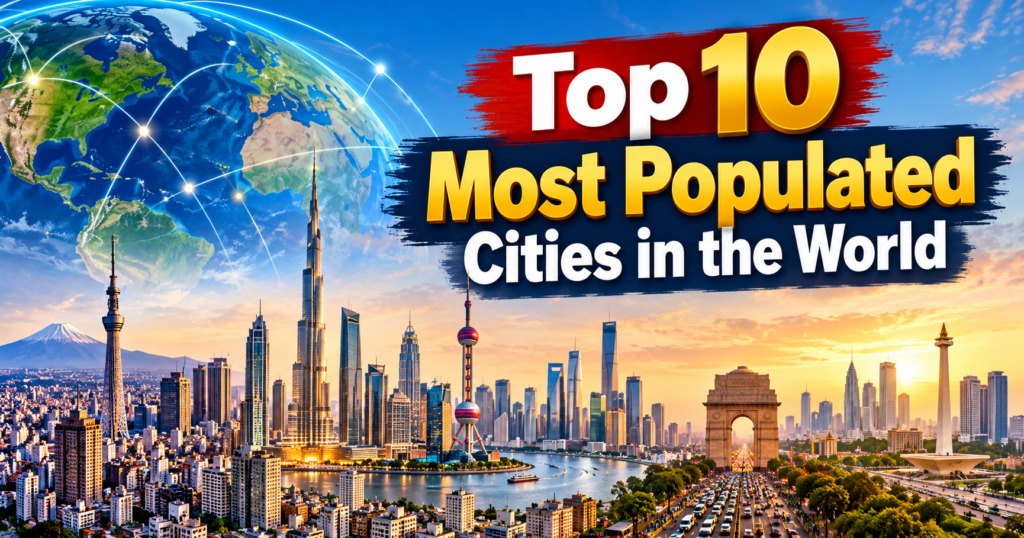

The world’s largest cities are major centres of population, business, transport, culture, and economic activity. As urban populations continue to grow, cities are expanding beyond their traditional boundaries, bringing together millions of people in connected urban areas.
According to the United Nations’ World Urbanization Prospects 2025, Jakarta, Indonesia, is the world’s most populated city under the report’s harmonised definition. Dhaka, Tokyo, and New Delhi also rank among the largest urban settlements globally. The UN estimates cover city populations in 2025 and provide projections through 2050.
This article explores the top 10 most populated cities in the world, their estimated populations, locations, and the factors contributing to their growth.
Top 10 Most Populated Cities in the World
The following ranking uses the UN’s 2025 population estimates based on its harmonised Degree of Urbanization methodology. Population figures are estimates, rounded to one decimal place.
1. Jakarta, Indonesia – 41.9 Million
Jakarta ranks as the world’s most populated city in the UN’s 2025 assessment, with an estimated population of approximately 41.9 million.
Located on the island of Java, Jakarta is Indonesia’s principal economic and commercial centre. Its wider urban area includes densely populated communities extending beyond the central city.
Key facts:
- Country: Indonesia
- Estimated population: 41.9 million
- Region: Southeast Asia
- Major activities: Finance, trade, manufacturing, transport, and services
Jakarta’s position reflects the scale of its connected urban area rather than the population within the administrative boundaries of the central city alone. The UN notes that different city definitions can produce substantially different population estimates and rankings.
2. Dhaka, Bangladesh – 36.6 Million
Dhaka is the second most populated city in the world under the UN’s 2025 methodology, with an estimated population of approximately 36.6 million.
As Bangladesh’s capital and a major economic centre, Dhaka attracts people seeking employment, education, healthcare, and business opportunities. The garment and textile industries play an important role in the wider economy, alongside trade and services.
Key facts:
- Country: Bangladesh
- Estimated population: 36.6 million
- Region: South Asia
- Major activities: Garments, manufacturing, trade, finance, and services
Dhaka’s large population reflects the concentration of economic activity and residential development in and around the capital.
3. Tokyo, Japan – 33.4 Million
Tokyo ranks third among the world’s most populated cities, with an estimated population of approximately 33.4 million under the UN’s 2025 comparison.
Tokyo is a leading international centre for finance, technology, business, transport, and culture. Its extensive rail network and interconnected urban districts support a large population across the metropolitan region.
Key facts:
- Country: Japan
- Estimated population: 33.4 million
- Region: East Asia
- Major activities: Finance, technology, manufacturing, research, and services
Although Tokyo remains one of the world’s largest urban centres, its population trajectory differs from those of many rapidly growing cities in South Asia. The UN projects that Tokyo’s population will decline over the coming decades.
4. New Delhi, India – 30.2 Million
New Delhi ranks fourth in the UN’s 2025 list, with an estimated population of approximately 30.2 million.
India’s capital forms part of the wider Delhi urban region, which includes major residential and employment centres in neighbouring areas. The region attracts people from across India for jobs, education, business, and government-related opportunities.
Key facts:
- Country: India
- Estimated population: 30.2 million
- Region: South Asia
- Major activities: Government, trade, information technology, finance, education, and services
Delhi’s position highlights the scale of India’s urban population and the importance of its national capital region as a centre for employment and economic activity.
5. Shanghai, China – 29.6 Million
Shanghai is one of China’s most important commercial and financial centres. With an estimated population of approximately 29.6 million, it ranks fifth among the world’s most populated cities in the UN’s 2025 assessment.
Situated on China’s eastern coast, Shanghai plays a major role in international trade, finance, manufacturing, and logistics. Its port and transport infrastructure connect businesses in China with global markets.
Key facts:
- Country: China
- Estimated population: 29.6 million
- Region: East Asia
- Major activities: Finance, shipping, manufacturing, trade, and technology
Shanghai’s economic importance extends well beyond its population. It is also a significant centre for international business and industrial activity.
6. Guangzhou, China – 27.6 Million
Guangzhou ranks sixth, with an estimated population of approximately 27.6 million.
Located in southern China, Guangzhou is a major commercial and manufacturing centre. It forms part of the highly urbanised Pearl River Delta region, which connects several large cities and industrial areas.
Key facts:
- Country: China
- Estimated population: 27.6 million
- Region: East Asia
- Major activities: Manufacturing, trade, logistics, automobiles, and technology
Guangzhou’s large urban population reflects the concentration of industry, trade, transport, and residential development in southern China.
7. Cairo, Egypt – 25.6 Million
Cairo is the seventh most populated city in the UN’s 2025 ranking, with an estimated population of approximately 25.6 million.
As Egypt’s capital, Cairo is a major centre for government, education, commerce, media, and transport. Its wider urban area serves as a focal point for employment and services across the country.
Key facts:
- Country: Egypt
- Estimated population: 25.6 million
- Region: North Africa
- Major activities: Government, commerce, education, tourism, and services
Cairo is notable for being the only city outside Asia in the UN’s 2025 top 10 list of the world’s most populated cities.
8. Manila, Philippines – 24.7 Million
Manila ranks eighth in the UN’s 2025 assessment, with an estimated population of approximately 24.7 million.
The wider Manila urban area is the Philippines’ principal centre for government, business, finance, education, and transport. Its connected urban districts support a large workforce and a diverse range of industries.
Key facts:
- Country: Philippines
- Estimated population: 24.7 million
- Region: Southeast Asia
- Major activities: Business services, finance, trade, logistics, and education
Manila’s population illustrates the importance of urban regions that extend beyond a central municipality and include numerous neighbouring communities.
9. Kolkata, India – 22.5 Million
Kolkata ranks ninth among the world’s most populated cities, with an estimated population of approximately 22.5 million.
Located in eastern India, Kolkata is a major centre for trade, transport, education, healthcare, and cultural activity. Its wider urban area supports commercial and industrial activity across the region.
Key facts:
- Country: India
- Estimated population: 22.5 million
- Region: South Asia
- Major activities: Trade, transport, education, healthcare, finance, and services
Kolkata’s inclusion in the global top 10 highlights the size of India’s urban population beyond its capital region.
10. Seoul, South Korea – 22.5 Million
Seoul completes the UN’s 2025 top 10 list, with an estimated population of approximately 22.5 million.
As South Korea’s capital and leading business centre, Seoul is known for its technology industries, financial services, advanced transport systems, education, and cultural influence.
Key facts:
- Country: South Korea
- Estimated population: 22.5 million
- Region: East Asia
- Major activities: Technology, finance, manufacturing, education, and services
Seoul’s extensive urban region connects residential districts, commercial centres, and industrial areas, supporting a large and economically diverse population.
Comparison of the Top 10 Most Populated Cities in the World
The table summarises the 2025 population estimates used in this article. Figures are rounded, so they may not add up precisely when compared with unrounded data.
| Rank | City | Country | Estimated Population in 2025 |
|---|---|---|---|
| 1 | Jakarta | Indonesia | 41.9 million |
| 2 | Dhaka | Bangladesh | 36.6 million |
| 3 | Tokyo | Japan | 33.4 million |
| 4 | New Delhi | India | 30.2 million |
| 5 | Shanghai | China | 29.6 million |
| 6 | Guangzhou | China | 27.6 million |
| 7 | Cairo | Egypt | 25.6 million |
| 8 | Manila | Philippines | 24.7 million |
| 9 | Kolkata | India | 22.5 million |
| 10 | Seoul | South Korea | 22.5 million |
Which Country Has the Most Cities in the Top 10?
China and India each have two cities in the UN’s 2025 top 10 list.
China is represented by Shanghai and Guangzhou, while India is represented by New Delhi and Kolkata. Indonesia, Bangladesh, Japan, Egypt, the Philippines, and South Korea each have one city in the ranking.
This distribution illustrates the importance of Asia in the global urban population landscape. Large urban regions across the continent are centres for employment, manufacturing, trade, transport, and public services.
Why Are the World’s Largest Cities Growing?
Several factors contribute to the growth of large urban areas.
Employment opportunities: Cities attract workers because they concentrate businesses, industrial facilities, offices, and service-sector jobs.
Migration: People often move to urban areas to access employment, education, healthcare, and other services.
Transport and infrastructure: Roads, railways, ports, airports, and public transport connect residential districts with employment and commercial centres.
Population growth: Natural population increase can contribute to the expansion of cities, although its importance varies by location.
Expansion of urban boundaries: Nearby towns and settlements can become connected to a major urban area as development spreads. This can substantially change a city’s measured population depending on how its boundaries are defined.
The UN’s 2025 assessment notes that the method used to define a city has a significant effect on population comparisons. Its harmonised methodology makes international comparisons more consistent than relying solely on each country’s administrative definitions.
What Is the Difference Between a City Proper and an Urban Agglomeration?
A city proper generally refers to a city within its legally defined administrative boundaries. An urban agglomeration or wider urban area includes connected built-up areas and may extend into surrounding municipalities.
A metropolitan area may use a broader definition that includes places linked through commuting, employment, and other economic relationships.
These terms are not interchangeable. A city may rank much higher when its surrounding urban settlements are included than when only the central municipality is counted.
For example, the UN’s 2025 assessment places Jakarta first under its harmonised methodology, while its older 2018 assessment used country-specific definitions that produced a substantially different result.
Important: When comparing the populations of cities in different countries, always check the definition, reference year, and source of the figures.
Conclusion
The world’s most populated cities demonstrate the scale and diversity of modern urban life. Jakarta leads the UN’s 2025 ranking, followed by Dhaka and Tokyo. New Delhi and Kolkata place India among the countries with multiple cities in the top 10, while Shanghai and Guangzhou highlight the scale of China’s urban regions.
Understanding these rankings requires more than comparing population figures alone. The definition of a city, its surrounding urban settlements, and the year of measurement all affect the result.
For accurate comparisons, the United Nations’ World Urbanization Prospects 2025 provides a consistent reference for examining the world’s largest urban populations.
Frequently Asked Questions
What is the most populated city in the world?
According to the United Nations’ World Urbanization Prospects 2025, Jakarta, Indonesia, is the world’s most populated city under the harmonised Degree of Urbanization methodology, with an estimated population of approximately 41.9 million in 2025.
Which city ranks second in world population?
Dhaka, Bangladesh, ranks second, with an estimated population of approximately 36.6 million in 2025 under the UN’s methodology.
Is Tokyo the largest city in the world?
Tokyo remains one of the world’s largest urban areas, but the UN’s 2025 assessment ranks Jakarta first and Tokyo third. Rankings differ when different definitions of city boundaries are used.
Which Indian cities are among the world’s most populated?
New Delhi and Kolkata appear in the UN’s 2025 top 10 list. Their estimated populations are approximately 30.2 million and 22.5 million, respectively, under the harmonized methodology.
How many people live in the world’s most populated city?
The UN estimates that Jakarta had approximately 41.9 million residents in 2025 under its harmonised urban definition. The figure includes the wider connected urban area rather than just the central municipality.
Will the world’s most populated cities change by 2050?
Yes. UN projections suggest that Dhaka could become the world’s most populated city by 2050, followed closely by Jakarta. These figures are projections rather than confirmed future populations and may change as demographic trends evolve.
Disclaimer
Population figures in this article are estimates for 2025, not exact live counts. The ranking follows the United Nations’ World Urbanization Prospects 2025 and its harmonised definition of cities. Rankings published by other sources may differ because they use different administrative boundaries, metropolitan-area definitions, reference years, or estimation methods.