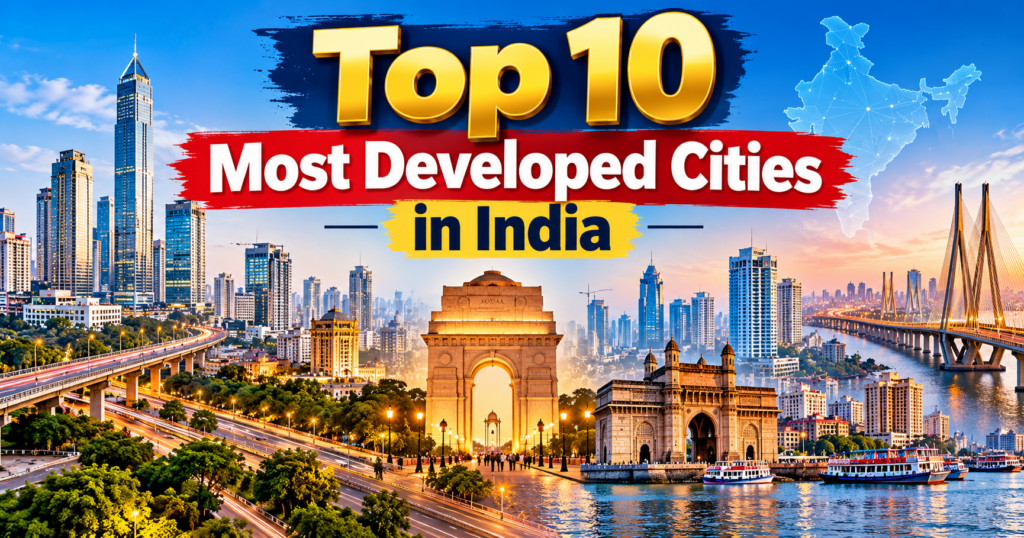

India’s cities are developing rapidly, supported by expanding industries, modern transport systems, digital infrastructure, commercial investment, and improvements in urban services. Cities such as Bengaluru, Mumbai, Delhi, Hyderabad, Pune, and Chennai are major economic centres, while Ahmedabad, Surat, and Coimbatore have established industrial and commercial ecosystems.
However, the most developed city in India is not necessarily the richest, largest, or most populated. Urban development also depends on public transport, roads, healthcare, education, water supply, sanitation, employment opportunities, and the quality of municipal services.
The top 10 most developed cities in India listed in this article are evaluated using a combination of economic activity, infrastructure, connectivity, industrial development, and urban services. The ranking is an editorial comparison rather than an official nationwide development index.
Top 10 Most Developed Cities in India
The following cities represent a mix of major metropolitan economies and well-established industrial centres. Their positions reflect a broad assessment of development rather than a single statistical measure.
1. Bengaluru, Karnataka
Bengaluru is one of India’s leading centres for technology, innovation, research, and corporate employment. Its concentration of technology companies, startups, multinational corporations, and research institutions has helped establish it as a major contributor to India’s modern services economy.
The city combines a substantial technology ecosystem with educational institutions, healthcare facilities, commercial districts, and an expanding public transport network.
Economic development: Bengaluru has a strong presence in information technology, software development, artificial intelligence, biotechnology, aerospace, and financial technology.
Infrastructure: The city has an international airport, an operational metro network, established road connections, and expanding transport infrastructure. Further metro and regional transport proposals aim to improve connectivity, although some remain under development.
Education and healthcare: Bengaluru has universities, engineering institutions, research centres, specialist hospitals, and medical colleges.
Employment opportunities: Technology professionals, researchers, engineers, entrepreneurs, and corporate employees benefit from its diversified employment market.
Major challenges: Traffic congestion, housing affordability, water stress, and pressure on civic infrastructure remain significant concerns.
Bengaluru is particularly notable for its technology-driven development. However, the pace of economic growth does not always translate into equally strong infrastructure or public services across every neighbourhood.
2. Mumbai, Maharashtra
Mumbai is India’s principal financial and commercial centre, with an economy spanning banking, financial services, entertainment, trade, logistics, and corporate headquarters.
The city is home to major financial institutions, stock exchanges, multinational businesses, and a large professional services sector. Its port, airport, and extensive transport connections also support domestic and international commerce.
Economic development: Banking, finance, insurance, media, entertainment, real estate, trade, and professional services are major economic sectors.
Infrastructure: Mumbai has suburban railways, metro services, major road connections, port infrastructure, and an international airport. Large transport and connectivity projects across the wider metropolitan region aim to improve movement between business and residential centres.
Education and healthcare: The city has established universities, medical colleges, specialist hospitals, and research institutions.
Employment opportunities: Finance professionals, business executives, media workers, technology employees, traders, and entrepreneurs have access to a broad employment market.
Major challenges: High housing costs, congestion, dense development, and flooding in vulnerable areas can affect daily life.
Mumbai’s development is closely connected to its financial institutions and commercial ecosystem. Its wider metropolitan region also includes important industrial, logistics, and residential centres, meaning development cannot be assessed solely by looking at the island city.
3. Delhi NCR
Delhi National Capital Region (NCR) is one of India’s most important economic and administrative regions. It includes Delhi and connected urban centres such as Gurugram, Noida, Greater Noida, and Ghaziabad.
The region benefits from government institutions, corporate offices, manufacturing, information technology, logistics, education, and a large consumer market.
Economic development: Government services, finance, consulting, IT, manufacturing, retail, logistics, and corporate services support the regional economy.
Infrastructure: Delhi NCR has an extensive metro network, major expressways, rail connectivity, and access to Indira Gandhi International Airport. The wider region also benefits from regional transport infrastructure, including the operational Delhi–Meerut Namo Bharat corridor.
Education and healthcare: The region has universities, research institutions, medical colleges, and major public and private hospitals.
Employment opportunities: Corporate professionals, government employees, consultants, technology workers, manufacturers, and business owners have access to a broad regional job market.
Major challenges: Air pollution, traffic congestion, high housing costs in selected areas, and uneven civic services remain important concerns.
Delhi NCR’s development is distributed across multiple cities. Gurugram has a substantial corporate office market, Noida has technology and manufacturing activity, and Greater Noida has industrial and planned-development areas. These differences make the region an important example of multi-city urban development.
4. Hyderabad, Telangana
Hyderabad has developed into a major centre for information technology, pharmaceuticals, biotechnology, healthcare, and corporate operations.
Its business districts attract domestic and international companies, while its pharmaceutical and life sciences industries provide an economic base beyond technology services.
Economic development: IT services, pharmaceuticals, biotechnology, financial services, healthcare, and corporate operations contribute to economic activity.
Infrastructure: Hyderabad has metro services, major road networks, an international airport, and expanding commercial districts. Connectivity and infrastructure quality vary across different parts of the metropolitan area.
Education and healthcare: The city has universities, engineering colleges, medical institutions, research centres, and specialist hospitals.
Employment opportunities: Technology professionals, pharmaceutical researchers, healthcare workers, financial specialists, and corporate employees have access to a range of opportunities.
Major challenges: Traffic congestion, hot summers, rising housing costs in popular locations, and pressure on water resources require continued attention.
Hyderabad’s development stands out because it combines modern corporate infrastructure with established pharmaceutical and life sciences industries. Its long-term progress depends on maintaining investment while ensuring that transport, housing, and public services keep pace with urban expansion.
5. Pune, Maharashtra
Pune is an important industrial, educational, and technology centre. Its economy combines automobile manufacturing, engineering, information technology, research, and professional services.
The presence of universities and technical institutions supports its workforce, while industrial areas and technology parks attract businesses from different sectors.
Economic development: Automotive manufacturing, engineering, IT services, education, research, and professional services are major contributors.
Infrastructure: Pune has road connections, rail services, an airport, and an expanding metro network. Public transport coverage and travel times vary by neighbourhood.
Education and healthcare: The city has universities, engineering institutions, research centres, medical colleges, and specialist hospitals.
Employment opportunities: Engineers, technology professionals, manufacturing specialists, researchers, and graduates have access to a diversified employment market.
Major challenges: Traffic congestion, rising housing costs near employment hubs, and uneven infrastructure development across the metropolitan area.
Pune’s development is supported by its combination of industrial activity and modern services. It also benefits from its location within Maharashtra’s wider commercial and manufacturing network.
6. Chennai, Tamil Nadu
Chennai is one of India’s major manufacturing, automotive, electronics, healthcare, and technology centres. Its industrial base, port facilities, educational institutions, and transport connections support both domestic commerce and international trade.
Economic development: Automobile manufacturing, electronics, IT services, engineering, healthcare, logistics, and industrial production are important sectors.
Infrastructure: Chennai has metro services, suburban rail, major roads, port facilities, and an international airport. Further transport improvements and industrial connectivity projects are important to the city’s development.
Education and healthcare: Chennai has established universities, engineering colleges, medical institutions, and specialist hospitals.
Employment opportunities: Engineers, manufacturing professionals, healthcare workers, technology employees, and logistics specialists benefit from the city’s diverse industries.
Major challenges: Hot and humid weather, traffic congestion, seasonal flooding in vulnerable areas, and water-management concerns.
Chennai’s development is particularly significant for manufacturing and industrial services. Its port and industrial ecosystem support business activity beyond the city itself, connecting it to national and international supply chains.
7. Ahmedabad, Gujarat
Ahmedabad is a major commercial and industrial centre in western India. Its economy includes manufacturing, textiles, pharmaceuticals, engineering, trade, finance, and professional services.
The city also benefits from its position within Gujarat’s wider industrial network, which connects manufacturing centres, commercial districts, and transport infrastructure.
Economic development: Manufacturing, textiles, pharmaceuticals, engineering, chemicals, finance, and trade are important sectors.
Infrastructure: Ahmedabad has metro services, BRTS bus services, road networks, rail connections, and an international airport. Connectivity with Gandhinagar and other commercial centres supports regional development.
Education and healthcare: The city has universities, management institutions, engineering colleges, medical colleges, and major hospitals.
Employment opportunities: Entrepreneurs, engineers, manufacturing professionals, pharmaceutical employees, financial specialists, and business owners have access to varied opportunities.
Major challenges: Very hot summers, increasing demand for urban services, and differences in infrastructure quality between neighbourhoods.
Ahmedabad’s development is closely connected to manufacturing, commerce, and infrastructure investment. Its established industrial base gives it a different economic profile from technology-focused cities such as Bengaluru.
8. Surat, Gujarat
Surat is a major industrial and commercial city known for its textile and diamond-processing industries. Its business ecosystem supports manufacturing, trade, logistics, and a wide range of small and medium-sized enterprises.
The city has also received attention for its municipal performance and urban services.
Economic development: Textiles, diamond processing, manufacturing, trade, and logistics are central to Surat’s economy.
Infrastructure: The city has road and rail connectivity, an airport, urban transport services, and a metro project under development. The pace and coverage of new infrastructure should be assessed separately from already operational facilities.
Education and healthcare: Surat has educational institutions, medical colleges, hospitals, and vocational training facilities.
Employment opportunities: Textile workers, diamond-sector professionals, traders, manufacturing specialists, and entrepreneurs contribute to the city’s employment base.
Major challenges: Industrial diversification, flood management, environmental pressures, and the need to expand infrastructure alongside population growth.
Surat’s development is notable for its strong business and manufacturing ecosystem. The city also performed well in the Government of India’s 2020 Ease of Living and Municipal Performance assessments, although those results are historical rather than a current 2026 ranking.
9. Navi Mumbai, Maharashtra
Navi Mumbai is a planned urban centre within the Mumbai metropolitan region. It was developed partly to accommodate urban expansion and provide alternative residential, commercial, and industrial locations outside Mumbai’s traditional core.
Its planned nodes, road network, transport connections, and commercial areas make it an important part of the wider metropolitan economy.
Economic development: Commercial services, logistics, warehousing, IT, retail, and regional business activity contribute to the economy.
Infrastructure: Navi Mumbai has road and rail connections, metro services on operational sections, and access to the wider Mumbai transport network. The Navi Mumbai International Airport adds another important element to the region’s transport infrastructure as operations and connectivity develop.
Education and healthcare: The city and surrounding region have schools, colleges, hospitals, and specialist medical facilities.
Employment opportunities: Professionals working in logistics, corporate services, retail, IT, and businesses across the Mumbai region may find suitable opportunities.
Major challenges: Housing affordability in well-connected areas, congestion on busy routes, and differences in public transport access between residential nodes.
Navi Mumbai is an example of planned urban development within a larger metropolitan economy. Its infrastructure and neighbourhood layout differ from Mumbai’s historic urban core, although daily commuting still depends heavily on workplace location and transport availability.
10. Coimbatore, Tamil Nadu
Coimbatore is a major industrial and educational centre in Tamil Nadu. Its economy is supported by engineering, textiles, manufacturing, healthcare, education, and information technology.
The city combines established industrial activity with residential neighbourhoods, educational institutions, and access to surrounding commercial areas.
Economic development: Engineering, textiles, machinery, manufacturing, healthcare, education, and IT services are important sectors.
Infrastructure: Coimbatore has road and rail connectivity, an airport, and established urban services. Public transport options and travel times depend on the route and neighbourhood.
Education and healthcare: The city has universities, engineering colleges, medical institutions, and specialist hospitals.
Employment opportunities: Engineers, manufacturing specialists, healthcare workers, educators, IT professionals, and entrepreneurs contribute to the city’s economy.
Major challenges: A smaller corporate employment market than India’s largest metropolitan centres, traffic congestion on busy routes, and the need for further public transport improvements.
Coimbatore’s development is based on its industrial and educational ecosystem rather than the scale of a major financial or technology metropolis. It remains an important example of a regional city with a substantial manufacturing base.
Comparison of the Most Developed Cities in India
The following table summarises the main strengths of each city. It is a qualitative comparison, not an official numerical ranking.
| City | Major economic strengths | Infrastructure profile | Main development advantage |
|---|---|---|---|
| Bengaluru | IT, technology, biotechnology, startups | Metro, airport, road networks | Technology and innovation |
| Mumbai | Finance, trade, media, corporate services | Suburban rail, metro, port, airport | Financial and commercial activity |
| Delhi NCR | Government, corporate services, IT, manufacturing | Metro, expressways, rail, airport | Large regional economy |
| Hyderabad | IT, pharmaceuticals, biotechnology | Metro, airport, road networks | Technology and life sciences |
| Pune | IT, engineering, automobiles, education | Metro, roads, rail, airport | Manufacturing and services |
| Chennai | Manufacturing, electronics, IT, healthcare | Metro, suburban rail, port, airport | Industrial and export activity |
| Ahmedabad | Manufacturing, trade, pharmaceuticals | Metro, BRTS, airport, roads | Industrial and commercial development |
| Surat | Textiles, diamonds, manufacturing | Roads, rail, airport, developing metro | Business and industrial ecosystem |
| Navi Mumbai | Logistics, commercial services, IT | Rail, roads, metro sections, airport development | Planned metropolitan expansion |
| Coimbatore | Engineering, textiles, education, healthcare | Roads, rail, airport | Regional industry and education |
What Makes a City Developed?
A city’s level of development cannot be measured by one indicator alone. A useful comparison considers several dimensions.
Economic development: A developed city usually has a diverse economy, established businesses, productive industries, and employment opportunities across multiple sectors.
Transport infrastructure: Roads, railways, metro systems, bus networks, airports, and last-mile connections influence how easily people travel and businesses operate.
Education and healthcare: Universities, schools, research institutions, hospitals, and specialist medical services contribute to the city’s human capital and quality of life.
Municipal services: Water supply, sanitation, waste management, drainage, electricity, and reliable public services are essential elements of urban development.
Digital infrastructure: Broadband connectivity, digital public services, telecommunications, and technology adoption support businesses and residents.
Environmental sustainability: Air quality, green spaces, water management, flood resilience, and efficient resource use affect whether urban development can be sustained.
Urban governance: Effective planning, transparent administration, municipal finances, and timely delivery of public services help cities manage growth.
A city can perform strongly in economic output but struggle with congestion or pollution. Another may have better municipal services relative to its size but fewer high-paying jobs. The most useful comparison therefore considers multiple indicators together.
Which is the Most Developed City in India?
There is no universally accepted single answer because different rankings measure different aspects of urban development.
Bengaluru is a strong contender when technology, innovation, and corporate employment are emphasised. Mumbai stands out for finance, trade, and commercial activity. Delhi NCR has a large and diverse regional economy, while Hyderabad and Pune combine expanding business ecosystems with substantial infrastructure and educational resources.
The Government of India’s Ease of Living Index 2020 placed Bengaluru first among participating cities with populations above one million, followed by Pune and Ahmedabad. Chennai and Surat also appeared in the top five. The assessment considered quality of life, economic ability, sustainability, resilience, and residents’ perceptions. These are official historical results, not a current 2026 ranking.
The government’s Municipal Performance Index 2020 measured local-government performance in areas such as services, finance, policy, technology, and governance. Indore ranked first among participating municipalities in the million-plus category, followed by Surat and Bhopal. This illustrates why municipal performance and overall economic development should not be treated as identical measures.
Consequently, the most developed city depends on whether the priority is economic strength, transport, public services, sustainability, or everyday living conditions.
Conclusion
Bengaluru, Mumbai, Delhi NCR, Hyderabad, Pune, Chennai, Ahmedabad, Surat, Navi Mumbai, and Coimbatore represent different models of urban development in India.
Bengaluru is known for technology and innovation, Mumbai for finance and commerce, and Delhi NCR for its diverse regional economy. Hyderabad and Pune combine corporate growth with established educational and industrial ecosystems, while Chennai, Ahmedabad, Surat, Navi Mumbai, and Coimbatore have their own strengths in manufacturing, trade, logistics, and urban development.
However, no city leads every development indicator. A meaningful assessment should consider economic activity alongside transport, public services, education, healthcare, environmental conditions, and urban governance.
The most developed city in India depends on the criteria used to measure development. Comparing several indicators provides a more reliable picture than relying on a single ranking or headline.
Frequently Asked Questions
Which is the most developed city in India?
There is no single universally accepted answer. Bengaluru, Mumbai, Delhi NCR, Hyderabad, and Pune are among the country’s major developed urban centres, but each has different strengths. The answer depends on whether development is measured through economic activity, infrastructure, municipal services, or quality of life.
Which Indian city has the best infrastructure?
Infrastructure varies by category. Delhi NCR has an extensive metro and regional transport network, Mumbai has major suburban rail and port infrastructure, and Bengaluru, Hyderabad, Chennai, and Pune have expanding metro and road systems. The best city depends on the type of infrastructure being compared.
Which is India’s most economically developed city?
Mumbai is widely recognized as India’s principal financial and commercial centre. Bengaluru is a major technology and innovation hub, while Delhi NCR has a diverse economy spanning government, corporate services, IT, manufacturing, and logistics. The answer depends on the economic measure used.
Which city is best for IT professionals?
Bengaluru, Hyderabad, Pune, and Chennai are major technology employment centres. Delhi NCR and Mumbai also have substantial technology and corporate services markets. Job availability depends on the specialization, employer, experience level, and salary expectations.
Which city has the best quality of life in India?
Quality of life depends on housing affordability, healthcare, education, safety, transport, environmental conditions, and public services. The Government of India’s 2020 Ease of Living Index placed Bengaluru first among participating million-plus cities, but those rankings should not be presented as a current 2026 assessment.
Which Indian city is most developed in terms of municipal services?
The answer depends on the services being assessed. The Government of India’s Municipal Performance Index 2020 ranked Indore first among participating municipalities in the million-plus category. That historical ranking measured municipal performance rather than every aspect of city development.
Are developed cities always better places to live?
Not necessarily. More developed cities may offer greater employment opportunities, specialist healthcare, and transport infrastructure, but they can also have high housing costs, congestion, pollution, and pressure on public services. The best place to live depends on individual circumstances and neighborhood-level conditions.
Are Tier-2 cities in India becoming more developed?
Yes, several Tier-2 cities are investing in transport, commercial infrastructure, industrial development, education, and urban services. Cities such as Surat and Coimbatore have established industrial bases, while others are developing new employment centres. However, the pace and quality of development vary considerably between cities.
Disclaimer
This article is provided for general informational and educational purposes only. The ranking is an editorial comparison and is not an official or universally accepted assessment of the most developed cities in India. City development varies according to the indicators, geographic boundaries, and reporting periods used. Government rankings cited in this article are historical where specified and should not be interpreted as current rankings. Readers should verify the latest information from government departments, municipal authorities, transport agencies, and other reliable sources before making decisions related to relocation, business, employment, or property.