
India’s urban landscape is changing rapidly as businesses expand, new industries emerge, infrastructure improves, and employment opportunities spread beyond traditional metropolitan centres. Cities such as Bengaluru, Hyderabad, Pune, and Chennai continue to attract corporate investment, while emerging urban centres such as Visakhapatnam, Surat, and Vijayawada are gaining attention for their growing employment markets and development potential.
The fastest-growing cities in India are not necessarily the country’s largest or wealthiest cities. Growth can be measured through employment, economic output, infrastructure investment, population increases, commercial development, and real estate activity. A city may perform strongly in one category without leading in every other category.
This article examines 10 Indian cities with notable growth momentum, explaining their major growth drivers, expanding industries, infrastructure developments, and the challenges that accompany rapid urbanisation.
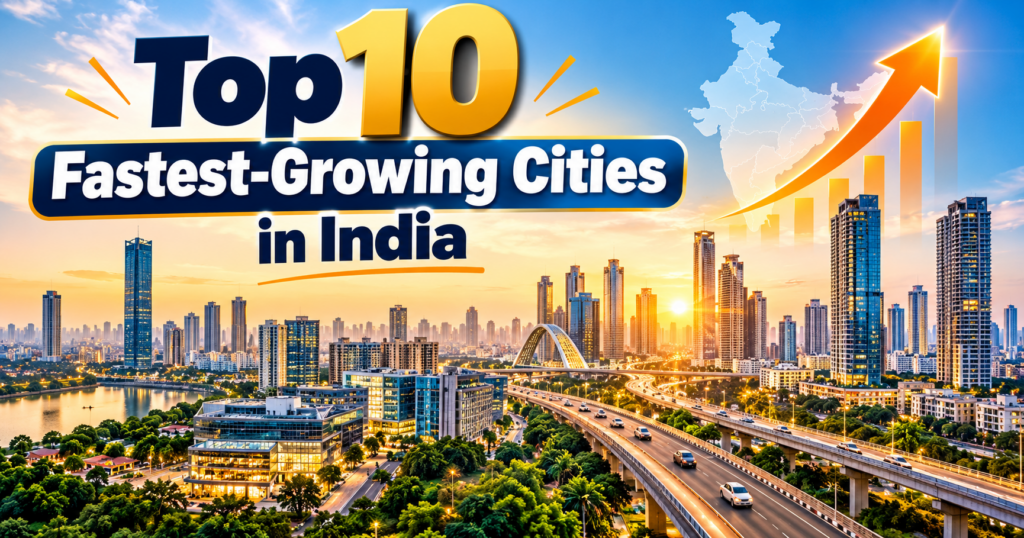
Top 10 Fastest-Growing Cities in India
The following is an editorial ranking based on a combination of business activity, employment opportunities, infrastructure development, and emerging economic potential. It is not an official government ranking, and the order may differ if cities are compared using a single metric such as GDP growth or job creation.
1. Bengaluru, Karnataka
Bengaluru remains one of India’s most important growth centres because of its technology industry, startup ecosystem, research institutions, and concentration of multinational companies.
The city attracts investment across software development, artificial intelligence, biotechnology, financial technology, and global capability centres (GCCs). These businesses support demand for skilled workers, commercial offices, housing, transport, and related services.
Major growth drivers: Information technology, startups, artificial intelligence, biotechnology, and global capability centres.
Infrastructure development: Metro expansion, road improvements, and regional transport planning are intended to improve connectivity across the Bengaluru metropolitan region.
Employment potential: Software engineers, data specialists, product managers, researchers, financial professionals, and startup employees.
Key challenges: Traffic congestion, housing affordability, water stress, and pressure on civic infrastructure.
Bengaluru is particularly relevant for people tracking technology-led urban growth. However, strong business activity does not automatically mean that every neighbourhood or industry is growing at the same rate.
2. Hyderabad, Telangana
Hyderabad has developed into a major destination for technology companies, pharmaceutical businesses, biotechnology firms, and corporate operations.
Its technology districts attract domestic and international employers, while its pharmaceutical and life sciences industries provide a broader economic base. This combination helps support commercial development, professional employment, housing demand, and investment in supporting infrastructure.
Major growth drivers: IT services, pharmaceuticals, biotechnology, financial services, and corporate offices.
Infrastructure development: Metro connectivity, road networks, airport access, and commercial development support the city’s expanding employment corridors.
Employment potential: Technology professionals, pharmaceutical researchers, healthcare workers, financial specialists, and corporate employees.
Key challenges: Traffic congestion, hot summers, rising housing costs in popular districts, and uneven access to infrastructure.
Hyderabad is worth watching because its economy is not dependent on a single industry. Technology and life sciences provide different sources of business activity, although their growth rates vary over time.
3. Pune, Maharashtra
Pune is an important growth centre for information technology, automobile manufacturing, engineering, education, and research.
The city’s industrial base and supply-chain connections complement its expanding services sector. Its universities and professional institutions also provide a large pool of graduates for technology, manufacturing, and business employers.
Major growth drivers: IT services, automotive manufacturing, engineering, electric vehicles, education, and professional services.
Infrastructure development: Metro development, road projects, and transport improvements aim to support expanding residential and employment areas.
Employment potential: Engineers, software developers, manufacturing specialists, researchers, and business professionals.
Key challenges: Traffic congestion, increasing housing costs in popular locations, and infrastructure pressure in fast-growing suburbs.
Pune’s combination of manufacturing and technology makes it an important city to monitor. Its growth is spread across multiple sectors, rather than relying entirely on one industry.
4. Chennai, Tamil Nadu
Chennai is a major centre for manufacturing, automotive production, electronics, IT services, logistics, and healthcare.
Its established industrial ecosystem attracts manufacturers and suppliers, while technology companies and corporate offices contribute to employment growth. The city’s port, transport connections, and industrial corridors also support commercial activity.
Major growth drivers: Automobile manufacturing, electronics, engineering, IT services, logistics, and healthcare.
Infrastructure development: Metro expansion, road projects, airport improvements, and industrial connectivity are important elements of the city’s development.
Employment potential: Manufacturing engineers, technology professionals, logistics specialists, healthcare workers, and electronics-sector employees.
Key challenges: Flood risk in vulnerable areas, hot and humid weather, traffic congestion, and water-management concerns.
Chennai’s growth profile is particularly relevant to manufacturing and industrial investment. Its performance should be evaluated alongside industrial production, employment, exports, and infrastructure capacity.
5. Delhi NCR, India
Delhi NCR is a major economic region rather than a single city. It includes Delhi and connected urban centres such as Gurugram, Noida, and Greater Noida.
The region has a diversified economy encompassing corporate offices, information technology, consulting, finance, manufacturing, logistics, retail, and real estate. Its large consumer market and connectivity make it an important destination for businesses.
Major growth drivers: Corporate services, IT, financial services, consulting, manufacturing, logistics, and commercial real estate.
Infrastructure development: Metro networks, expressways, regional transport projects, and airport-related infrastructure support movement across the region.
Employment potential: Corporate professionals, technology employees, consultants, manufacturing workers, logistics specialists, and entrepreneurs.
Key challenges: Air pollution, traffic congestion, water stress, high housing costs in certain areas, and coordination across multiple local authorities.
Delhi NCR’s growth is distributed across different urban centres. Gurugram has a strong corporate office market, Noida has technology and electronics activity, and Greater Noida has industrial and planned-development areas.
Because the region includes multiple cities, its economic performance should not be confused with the growth rate of Delhi city alone.
6. Surat, Gujarat
Surat is an important commercial and industrial centre with established diamond-processing and textile industries. Its business ecosystem also supports trade, manufacturing, logistics, and related services.
The city is frequently discussed as an emerging growth centre because of its industrial base, entrepreneurial activity, and infrastructure development.
Major growth drivers: Textiles, diamond processing, manufacturing, trade, and logistics.
Infrastructure development: Transport improvements, urban services, and regional connectivity are important to the city’s future expansion.
Employment potential: Textile workers, diamond-sector professionals, traders, manufacturing specialists, and small-business owners.
Key challenges: Industrial diversification, environmental management, flood exposure in vulnerable areas, and the need to expand civic services alongside urban growth.
Surat is especially relevant when examining industrial and business-led urban development. However, its growth should be measured using specific indicators such as industrial output, employment, investment, and productivity rather than assuming that every sector is expanding equally.
7. Ahmedabad, Gujarat
Ahmedabad combines established manufacturing industries with growing activity in pharmaceuticals, finance, engineering, trade, and professional services.
Its position within Gujarat’s commercial and industrial network supports business development. The nearby GIFT City financial district also contributes to the wider region’s financial-services ecosystem, although GIFT City is a separate planned development rather than simply another Ahmedabad neighbourhood.
Major growth drivers: Manufacturing, pharmaceuticals, textiles, chemicals, engineering, finance, and trade.
Infrastructure development: Metro connectivity, road improvements, and regional links support access between residential, commercial, and industrial areas.
Employment potential: Engineers, manufacturing professionals, pharmaceutical employees, financial-services workers, and entrepreneurs.
Key challenges: Extreme summer temperatures, pressure on urban services, and the need to expand high-value employment opportunities.
Ahmedabad’s growth profile combines traditional industry with emerging financial and professional services. Its long-term performance will depend partly on productivity, investment, infrastructure, and the ability to attract and retain skilled workers.
8. Visakhapatnam, Andhra Pradesh
Visakhapatnam, also known as Vizag, is an important coastal city with potential across port-related industries, logistics, manufacturing, tourism, education, and technology services.
Its port and industrial base provide established economic activity, while new investment proposals and regional development initiatives have brought additional attention to the city.
Major growth drivers: Port logistics, industrial activity, manufacturing, tourism, education, and technology services.
Infrastructure development: Port-related facilities, road connectivity, industrial projects, and proposed regional investments are important to the city’s development prospects.
Employment potential: Logistics professionals, engineers, manufacturing workers, tourism employees, and technology-sector workers.
Key challenges: Project execution, diversification of employment, coastal environmental management, and the need to convert announced investments into operational businesses.
Visakhapatnam is notable because emerging employment opportunities are increasingly being discussed outside India’s largest metropolitan centres. However, proposed investments and memorandums of understanding should not be treated as completed projects or guaranteed job creation.
9. Kochi, Kerala
Kochi is an important commercial centre in Kerala, supported by port activity, trade, tourism, healthcare, education, and information technology.
Its coastal location and established commercial infrastructure help connect businesses to domestic and international markets. Technology parks and professional services also provide opportunities beyond traditional trade and tourism.
Major growth drivers: Port logistics, tourism, IT services, healthcare, trade, and professional services.
Infrastructure development: Metro services, transport links, airport access, and port-related infrastructure support the wider urban economy.
Employment potential: IT professionals, logistics specialists, tourism employees, healthcare workers, and service-sector professionals.
Key challenges: Flooding and coastal risks, traffic congestion, uneven public transport access, and the need to expand high-paying employment opportunities.
Kochi offers a different growth profile from technology-heavy cities such as Bengaluru. Its commercial, tourism, healthcare, and logistics sectors create several sources of economic activity, although their contributions vary from year to year.
10. Vijayawada, Andhra Pradesh
Vijayawada is an important commercial and transport centre in Andhra Pradesh. Its location supports trade, logistics, retail, education, healthcare, and services for surrounding districts.
The wider Vijayawada–Amaravati region also attracts attention because of plans and investment initiatives related to administrative infrastructure, urban development, and regional connectivity.
Major growth drivers: Trade, logistics, retail, education, healthcare, and regional services.
Infrastructure development: Road and rail connectivity, regional transport improvements, and development initiatives in the surrounding region may influence future growth.
Employment potential: Traders, logistics workers, educators, healthcare professionals, service-sector employees, and small-business owners.
Key challenges: The conversion of proposed developments into completed projects, water and flood management, and the need for a broader base of high-value private-sector jobs.
Vijayawada’s future growth depends on both its existing commercial role and the development of the wider region. Announced projects should be evaluated separately from infrastructure that is already operational.
Comparison of the Fastest-Growing Cities in India
The following table summarises the main growth drivers of the ten cities. It is a qualitative comparison, not a numerical ranking of annual growth rates.
| City | Major growth sectors | Main growth characteristic | Important consideration |
|---|---|---|---|
| Bengaluru | IT, startups, biotechnology | Technology and corporate expansion | Congestion and water stress |
| Hyderabad | IT, pharmaceuticals, life sciences | Diversified corporate growth | Housing costs and traffic |
| Pune | IT, automotive, engineering | Manufacturing and services | Infrastructure pressure |
| Chennai | Manufacturing, electronics, IT | Industrial and export-oriented activity | Flood and water-management risks |
| Delhi NCR | Corporate services, IT, logistics | Large, diversified regional economy | Pollution and uneven regional development |
| Surat | Textiles, diamonds, manufacturing | Industrial and entrepreneurial growth | Diversification and urban services |
| Ahmedabad | Manufacturing, finance, pharmaceuticals | Industrial and commercial expansion | Heat and infrastructure needs |
| Visakhapatnam | Ports, logistics, manufacturing | Emerging investment and employment centre | Project execution |
| Kochi | Trade, tourism, IT, healthcare | Services and coastal commerce | Coastal risks and job diversification |
| Vijayawada | Trade, logistics, regional services | Commercial and regional development | Delivery of planned projects |
How Is the Growth of a City Measured?
There is no single indicator that can reliably identify the fastest-growing city in every context. Different measures answer different questions.
Economic growth: Measures the increase in economic output over time. City-level GDP estimates may use different boundaries and methodologies, making direct comparisons difficult.
Employment growth: Measures changes in jobs, hiring, or professional opportunities. It can help identify cities where people may find expanding career options, but a rise in job postings does not necessarily equal the same increase in permanent employment.
Infrastructure development: Includes transport systems, roads, utilities, industrial facilities, airports, and other public or private projects. Announcements, construction, and completed infrastructure should be evaluated separately.
Real estate growth: Can refer to housing sales, rental values, property prices, office leasing, or new construction. These indicators are related but not interchangeable. Rising property prices alone do not prove that a city has a strong or sustainable economy.
Population growth: Reflects changes in the number of residents. Population increases can expand the workforce and consumer market, but they can also put pressure on housing, water, transport, and public services.
Business investment: Includes capital expenditure, new facilities, business expansions, and other investment activity. Announced investment is not the same as investment already deployed.
A credible ranking should identify which indicators it uses, the period being measured, and whether the figures describe the city proper, its metropolitan area, or a wider economic region.
Which Indian Cities Are Growing Fastest in Terms of Jobs?
The answer depends on whether the comparison covers all employment, technology jobs, professional hiring, or emerging non-metropolitan job markets.
Bengaluru, Hyderabad, Pune, Chennai, and Delhi NCR remain important employment centres because of their established corporate and industrial ecosystems.
At the same time, smaller cities are attracting attention. LinkedIn’s 2026 Cities on the Rise reporting identified Visakhapatnam as a leading emerging non-metropolitan job market, alongside cities including Ludhiana, Surat, Vadodara, and Prayagraj. This reflects a specific employment-related measure, not a universal ranking of overall city growth.
When evaluating job opportunities, consider:
- The number of relevant vacancies in your industry.
- Whether hiring is increasing over several quarters.
- Salary levels relative to housing and commuting costs.
- The range of employers and career paths available.
- Whether new facilities are operational or only announced.
For job seekers, the city with the fastest overall growth may not be the best choice if its expanding industries do not match their skills or experience.
Which Fastest-Growing Cities Have Strong Infrastructure Development?
Infrastructure development varies by project type, funding, implementation schedule, and the stage of completion.
Bengaluru: Metro expansion and regional transport planning are intended to improve connectivity across the metropolitan region.
Hyderabad: Metro, road, and airport connectivity support major employment and commercial districts.
Pune: Transport improvements are important to connecting established urban areas with expanding residential and employment corridors.
Chennai: Metro development, industrial connectivity, and transport infrastructure support its manufacturing and services economy.
Delhi NCR: Metro networks, expressways, and regional transport links connect multiple cities and employment centres.
Visakhapatnam and Vijayawada: Regional infrastructure and investment proposals may support future growth, but their actual impact depends on execution and completion.
Infrastructure plans should be checked against official project updates. A proposed metro line, expressway, industrial corridor, or township should not be described as operational until it has actually entered service.
What Are the Challenges of Rapidly Growing Cities?
Rapid growth can create employment and investment opportunities, but it can also put pressure on public services and the environment.
Traffic congestion: More residents, jobs, and vehicles can increase commuting times when transport capacity does not keep pace with demand.
Housing affordability: Strong employment growth can increase rents and property prices, particularly near major business districts.
Water and energy demand: Growing populations and industries require reliable utilities, efficient distribution, and long-term resource planning.
Air and environmental quality: Construction, transport, industrial activity, and urban expansion can create pollution and environmental-management challenges.
Uneven development: Growth may be concentrated in certain neighbourhoods or industries, leaving other areas with fewer opportunities.
Project delivery: Announced investments and infrastructure proposals do not guarantee that construction will be completed on schedule or that expected jobs will materialise.
The most sustainable urban growth occurs when economic expansion is accompanied by effective planning, reliable public services, environmental management, and opportunities for a broad range of residents.
Conclusion
India’s urban growth is being shaped by established metropolitan economies and emerging regional centres. Bengaluru, Hyderabad, Pune, Chennai, and Delhi NCR have broad corporate and industrial ecosystems, while Surat, Ahmedabad, Visakhapatnam, Kochi, and Vijayawada offer different forms of industrial, commercial, and regional development potential.
The best way to identify a fast-growing city is to look beyond headlines and compare measurable indicators such as employment, business investment, economic output, infrastructure delivery, and population change over a defined period.
For job seekers, the most relevant city is the one with expanding opportunities in their field. For businesses, it is the city with the right customers, workforce, connectivity, and operating conditions. For residents, sustainable growth also depends on housing affordability, transport, utilities, and quality of life.
Ultimately, the fastest-growing city depends on what is growing, how quickly it is growing, and whether that growth can be sustained.
Frequently Asked Questions
Which is the fastest-growing city in India?
There is no single universally accepted answer because growth can mean GDP, employment, population, infrastructure, or real estate activity. Bengaluru is a major technology and corporate growth centre, while Visakhapatnam has been highlighted in 2026 reporting on emerging non-metropolitan employment markets.
Which Indian cities are growing fastest in 2026?
Bengaluru, Hyderabad, Pune, Chennai, and Delhi NCR remain important centres of business and employment activity. Surat, Visakhapatnam, Ahmedabad, Kochi, and Vijayawada are also relevant when examining industrial development, emerging employment, and regional investment. The exact order depends on the metric and period used.
Which city in India has the fastest job growth?
The answer depends on the sector and dataset. Bengaluru is a major technology employment hub, while Hyderabad, Pune, Chennai, and Delhi NCR have substantial corporate and industrial job markets. Visakhapatnam and other non-metropolitan cities are also attracting attention in employment-focused reports.
Which are the fastest-growing Tier-2 cities in India?
Cities frequently discussed as emerging Tier-2 growth centres include Visakhapatnam, Surat, Vadodara, Vijayawada, and Kochi. However, city classifications vary by source, and the fastest-growing city depends on whether the focus is hiring, industry, infrastructure, or population.
Which Indian cities are growing fastest in real estate?
Real estate performance varies by property type and time period. Bengaluru, Hyderabad, Pune, Chennai, and Delhi NCR have major office and residential markets, while other cities may experience stronger growth in particular segments. Property prices, rental values, office leasing, housing sales, and new supply should be evaluated separately.
Is Bengaluru growing faster than Hyderabad?
The comparison depends on the indicator. Bengaluru has a large technology ecosystem and substantial office demand, while Hyderabad has strong technology and life sciences sectors. Hiring, office leasing, population growth, and property prices may show different trends, so no single measure establishes which city is growing faster overall.
Are emerging cities better than metropolitan cities for investment?
Not necessarily. Emerging cities may offer opportunities linked to industrial expansion, infrastructure, or new employment centres, but they may also have greater uncertainty around project execution, liquidity, and demand. Investment decisions should consider the specific asset, location, price, risks, and time horizon.
Does rapid city growth guarantee better living conditions?
No. Economic expansion can create jobs and improve services, but it can also increase housing costs, congestion, pollution, and pressure on utilities. Living conditions depend on how effectively a city manages growth and distributes infrastructure and public services.
Disclaimer
This article is provided for general informational and educational purposes only. The list is an editorial comparison, not an official or universally accepted ranking of India’s fastest-growing cities. Growth indicators differ by source, geographic boundary, sector, and reporting period. Investment announcements, proposed infrastructure, hiring data, and real estate trends may change and should be verified with official government departments, city authorities, employers, research organisations, and relevant industry reports. This article is not financial, property-investment, or career advice.